Answered 24/7 across Little Rock and the Texarkana area
Bucket truck tree work around Little Rock
Some trees should not be climbed. A dead pine that snaps under a climber's weight, a tree leaning over a street, a row of tall pines along an open lot: from a bucket, the crew reaches the top without trusting the tree to hold them.
- Aerial lift removals and trimming
- Dead and brittle trees
- Answered 24/7
Short answer
Bucket truck tree work around Little Rock depends on one constraint: the truck has to park within reach of the tree on ground firm enough to carry it. Where it can, the lift is often the fastest and safest way to remove a dead or brittle tree or trim along a street, because nobody's weight goes into the tree itself.
Updated October 2026
When a lift beats a climber
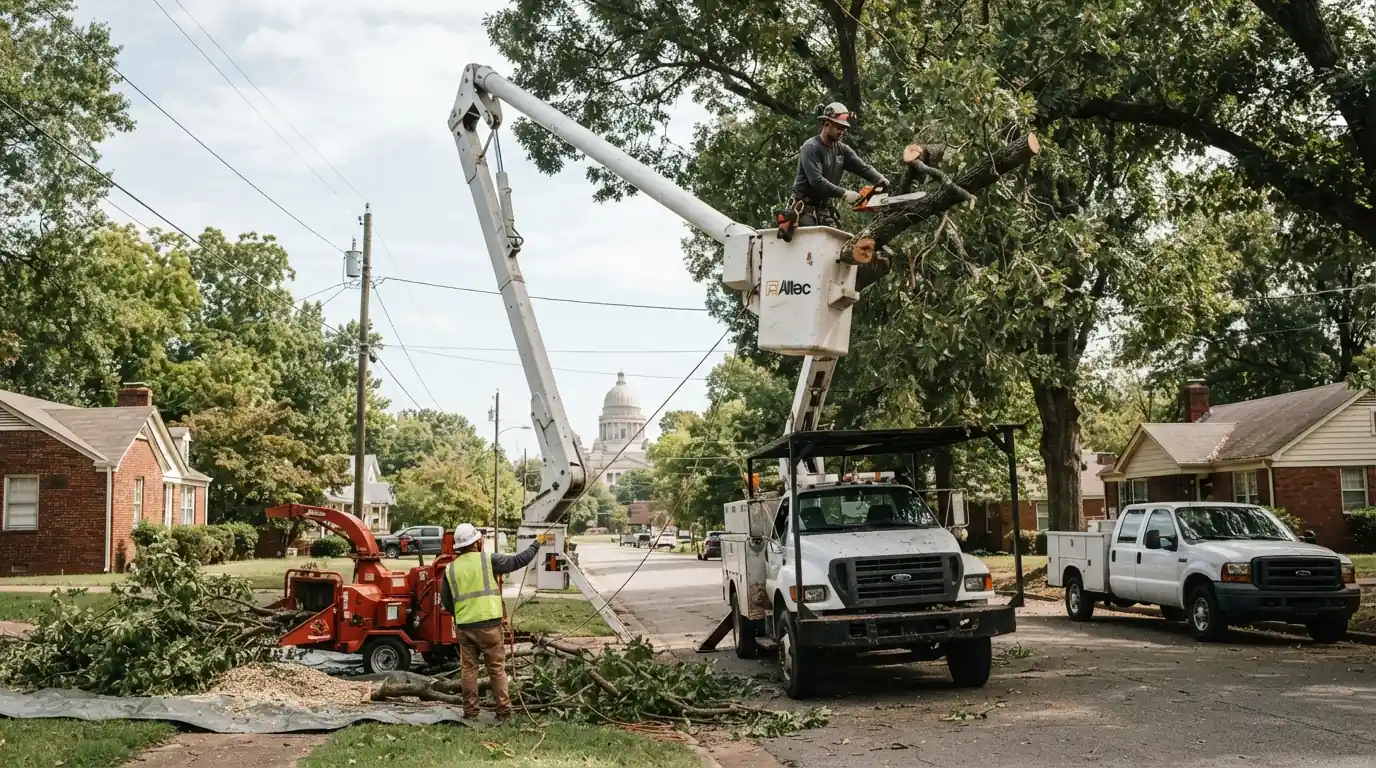
A climber is the right choice in most backyards: ropes reach places no truck can. A bucket wins when the tree is unsafe to load, when the work runs along a street or lot edge the truck can reach, or when many trees need the same cut in one day.
From the bucket, the operator cuts from outside the canopy and lowers pieces to the ground crew. The chipper runs alongside, so a row of trees is cleared in a single pass.
Compare
Climb, lift or crane
| Factor | Climber with ropes | Bucket truck | Crane |
|---|---|---|---|
| Best for | Sound trees in backyards | Brittle trees within reach of the truck | Big trees over houses with no drop zone |
| Needs | A tree safe to load | Firm ground and a clear path | A setup spot and lift clearance |
| Speed | Moderate | Fast on tall pines and rows | Fast once set up |
| Lawn impact | Low | Mats on soft ground | Mats and outrigger pads |
| Dead trees | Only if the wood is sound | Yes | Yes |
What moves the price
What decides the price of bucket truck work
Local market guidance: $174 to $232 per hour for a three-person crew (planning range from published 2026 figures, not our quote; every job is priced on site).
Truck access
A clear driveway or street spot versus a long lawn crossing.
Ground condition
Soft or wet ground needs mats or another day.
Tree height
The taller the tree, the more lift sets and sections.
Number of trees
A row done in one pass costs less per tree.
Dead or live wood
Brittle trees take slower, smaller cuts.
Haul-off volume
Pine trunk rounds are heavy and bulky to load.
Tall pine topping-down removal
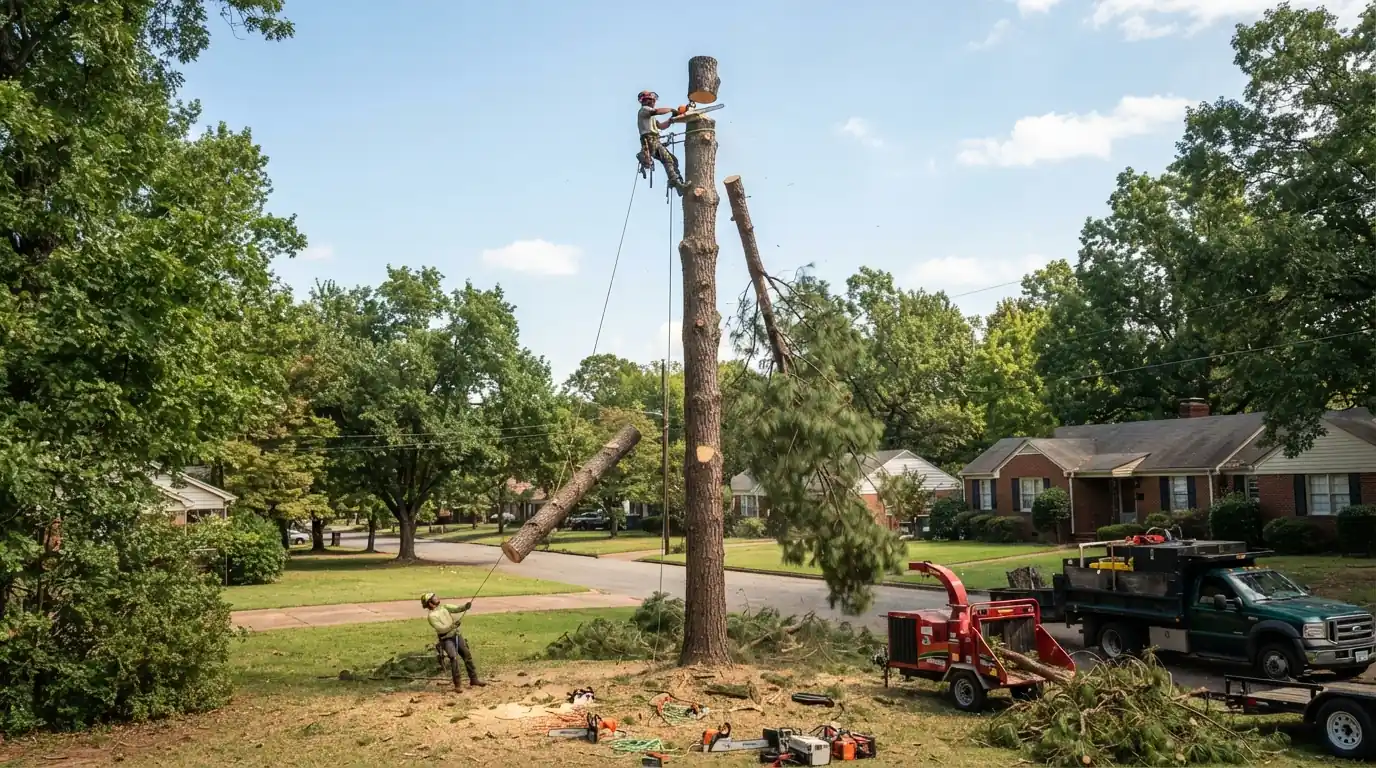
Pines are the trees we most often take down from a lift. The top comes off first in short pieces, then the trunk is taken down in sections from the bucket until the rest can be felled safely or lowered. It is quicker than rigging a climb on a tall straight pine, and when the tree is dead it removes the risk of the top breaking under a climber. The limit is reach: the truck needs a clear path and a firm place to set up.
Work over wide lawns and lots
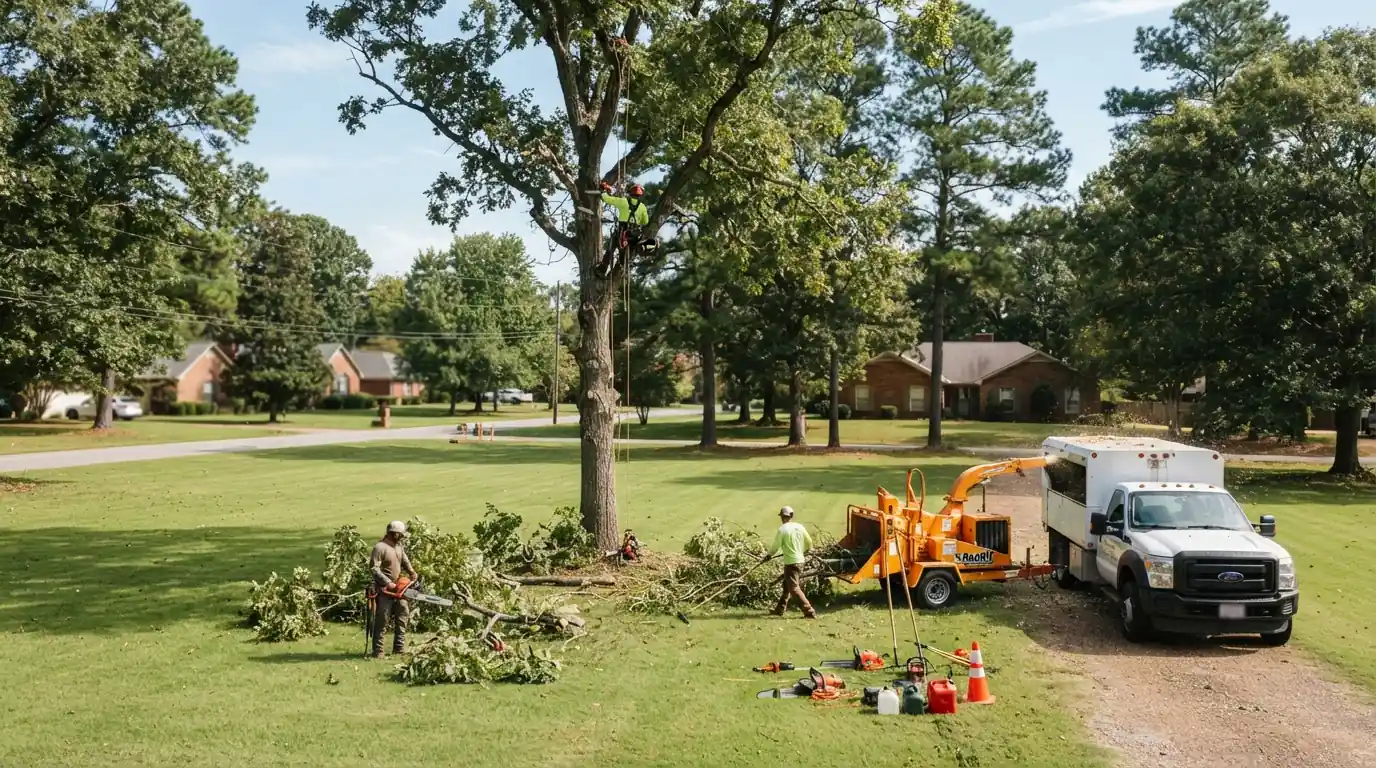
Open ground is where the bucket earns its keep. Along a lot line, a pasture fence or a commercial frontage, the truck moves tree to tree, trimming or removing without the crew having to re-rig each one. Soft ground after rain is the catch; we use mats or wait a day rather than rut a lawn or get the truck stuck, and we tell you plainly if the yard cannot take the weight. Gravel drives and gates wide enough for the truck make a big difference.
Dead trees too brittle to climb
Dead wood loses the flex that lets a climber tie in and trust a limb. Once a tree has been dead a season or more, especially a pine, the crew lead may rule out climbing entirely. The bucket lets the operator cut from outside the tree, and whatever cannot be reached from the truck is handled with a crane or felled when the ground allows. This is the most common reason a job we planned as a climb switches to the lift.
How this job runs around Little Rock
The loblolly pine is the tree that makes a bucket truck worth having in this part of the state. Arkansas is more than half forest, loblolly dominates the pine belt that runs across southwest Arkansas to the Texarkana side of the state line, and the oak-pine uplands around Little Rock put tall pines in plenty of yards too. Straight, tall and top-heavy, they section cleanly from a lift, which is why most of our dead pine removals start with the truck.
Equipment on tree jobs
The saw, chipper, grinder and rigging brands common across tree work
Step by step
How a bucket truck job runs
- 1
Call and describe the trees
Species, height, and where a truck could park.
- 2
Crew lead checks access
Ground, overhead lines and the reach needed.
- 3
Set up the truck and cones
Outriggers on firm ground or mats, work zone marked.
- 4
Cut from the bucket
Pieces lowered or dropped to a clear landing zone.
- 5
Chip, load and clean
Brush chipped, rounds loaded, street and lawn cleaned.
Straight answers
Questions we get about this
When the tree is too brittle to climb, when the truck can reach several trees, or when street-side work is faster from a lift.
We use mats on soft ground and will wait for it to dry rather than rut the yard.
Only if there is a clear, firm path. Most tight backyards are climbing or crane jobs.
We stay clear of Entergy's primary lines; that work belongs to the utility. Service drops to the house are planned before any cut.
Not necessarily. On tall pines it is often faster than a climb, which offsets the equipment.
Yes. That is some of the most efficient lift work we do.
The rest is climbed, felled on open ground, or lifted out with a crane.
Related work
Other jobs we handle near this one
Brush & Debris Hauling
Brush Pile Removal and more.
Brush & Debris Hauling in Little RockFirewood Cutting & Splitting
Cutting Rounds to Stove Length and more.
More on firewood cutting & splittingDriveway & Access Road Clearing
Overgrown Rural Driveways and more.
Driveway & Access Road Clearing in Little Rock
Tell us about the tall one
Call any hour with the tree and where a truck could park. We will tell you whether it is a lift, climb or crane job.