Answered 24/7 across Little Rock and the Texarkana area
Vine and ivy removal from trees in Little Rock
Vines look harmless at the base of a tree and do their damage higher up: shading out leaves, adding weight to the crown, catching wind and ice, and hiding cracks and decay in the trunk that nobody can see until something breaks.
- Vines cut at the base
- Trunks cleared
- Answered 24/7
Short answer
Vine and ivy removal from trees in Little Rock starts with cutting every stem at the base and clearing a ring around the trunk, then pulling or cutting the growth that can be reached safely in the canopy. Vines in the crown are left to die and drop over the following months rather than ripped down, which would tear bark and branches with them.
Updated October 2026
Why vines are a tree problem, not just a looks problem
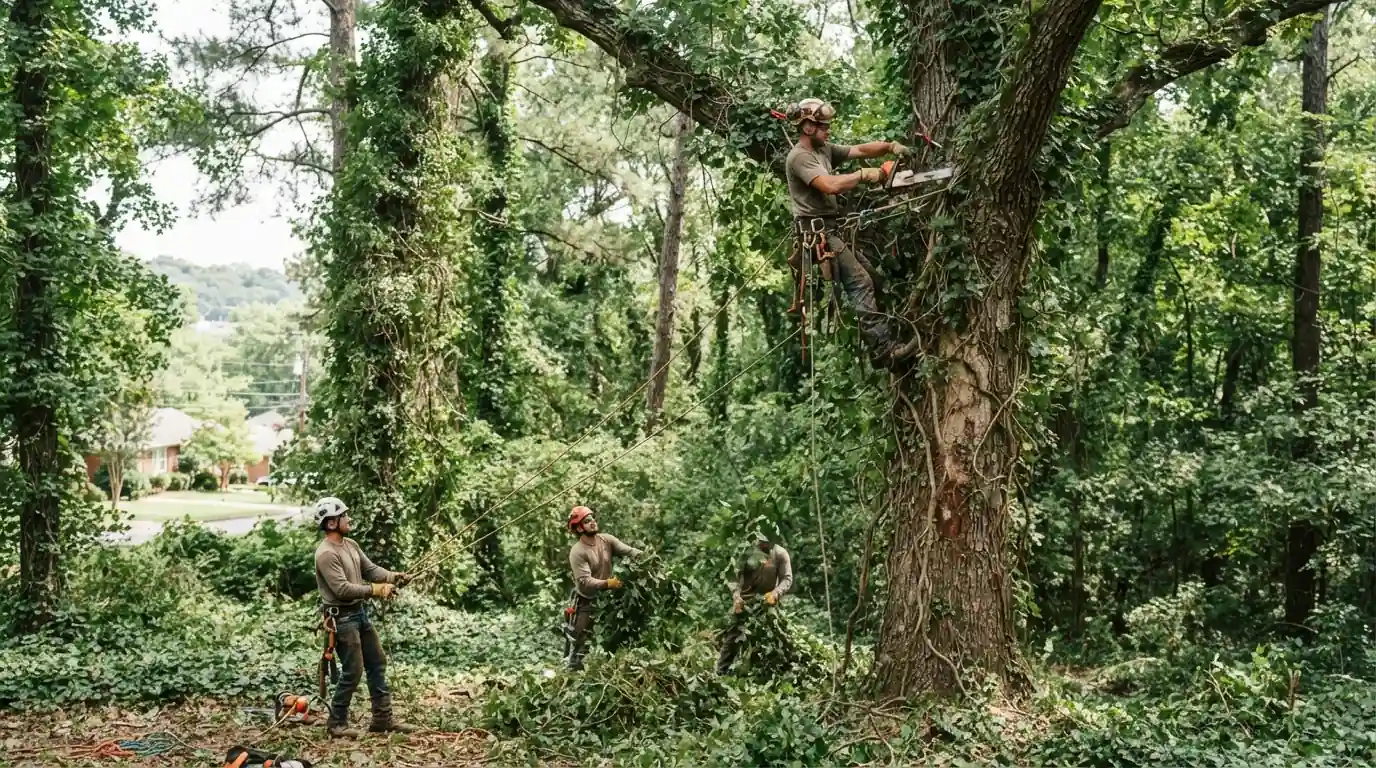
Heavy vine growth shades the tree's own leaves, holds moisture against the bark, and adds weight and wind resistance high in the crown. In an ice storm, a vine-covered crown carries far more load.
Vines also hide defects. A cavity, crack or fungal conk under a sheet of ivy goes unnoticed until the tree fails. Clearing the trunk is often when those problems finally come to light.
English ivy on trunks
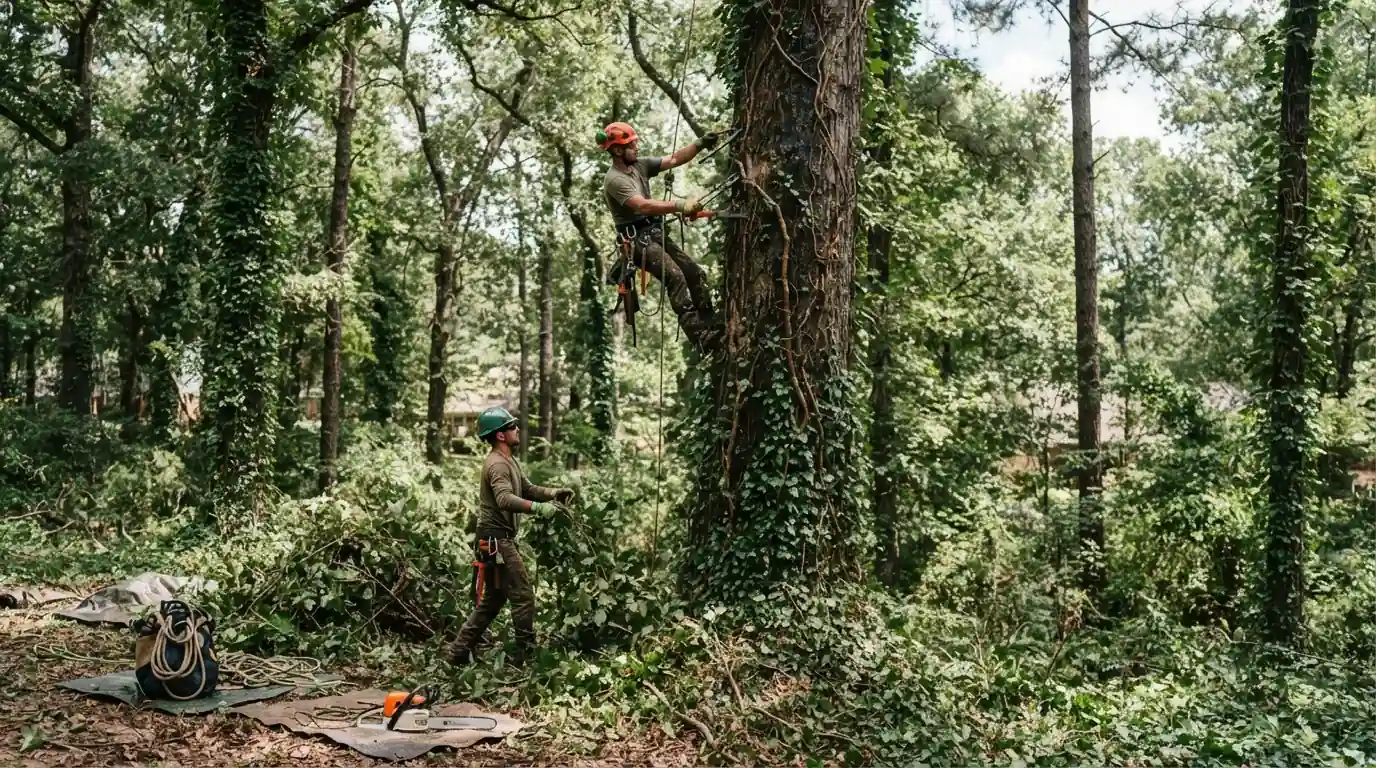
Ivy climbs trunks in a dense mat and eventually reaches into the crown. We cut every stem at about shoulder height and again near the ground, remove the section between, and clear a ring of ground ivy a few feet around the base so it cannot climb straight back up. The ivy above the cut dies and loosens over the following months; pulling it off while alive strips bark. Once the trunk is visible, we look for decay the ivy was hiding.
Wisteria and grapevine in the canopy
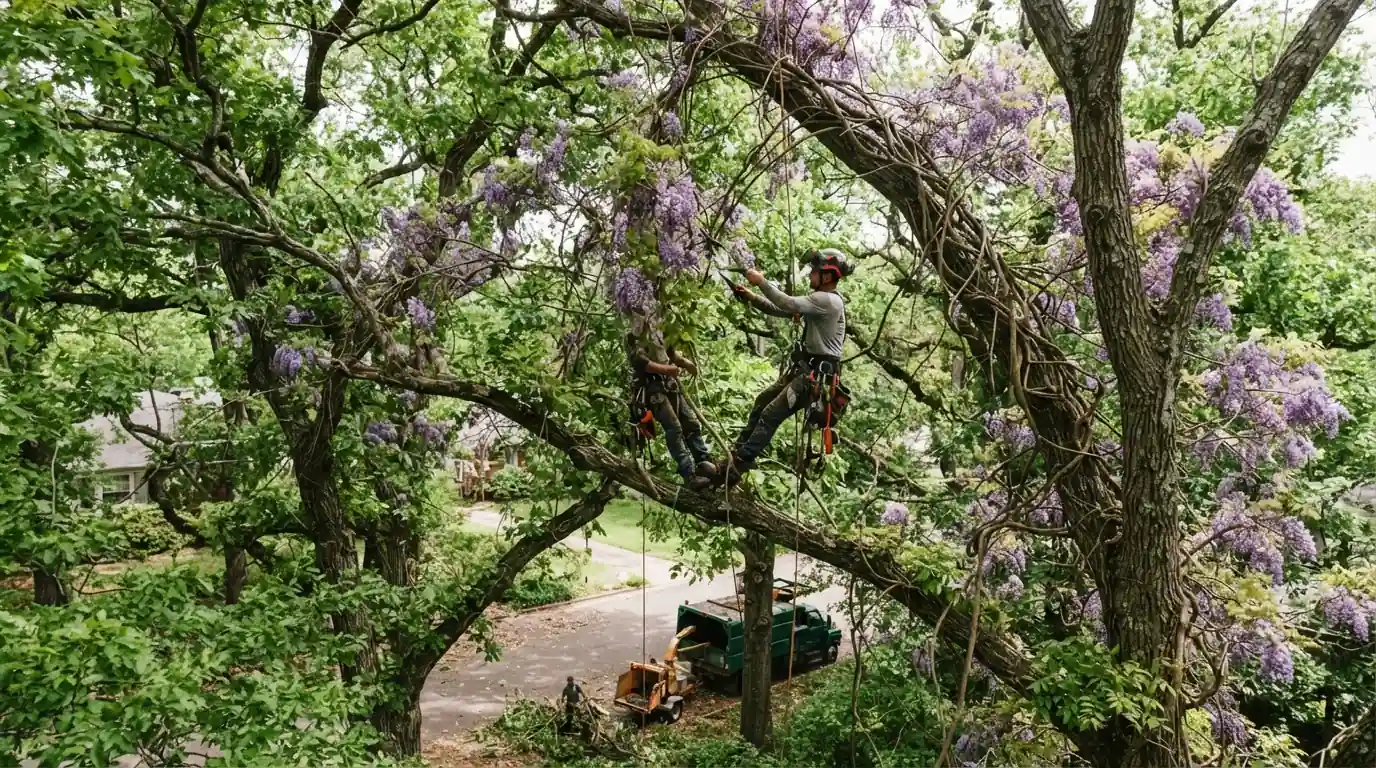
Woody vines like wisteria and wild grape can grow as thick as a wrist and wrap limbs tightly enough to girdle them. They also tie trees together, so when one falls it pulls on the next. We cut them at the base, climb where needed to cut and free vines wrapped around limbs, and lower the heavy sections rather than yanking them out of the crown. Cut stumps of aggressive vines resprout, so the base gets checked again the following season.
Poison ivy on trees
Poison ivy on a trunk can grow hairy stems thicker than a thumb, and every part of it carries the oil that causes the rash, even in winter. Crews wear full cover and cut the vine at the base, and we do not burn it, since the smoke carries the oil. Dead vines left on the tree are still irritating, so we tell you what to avoid touching until they break down or are removed.
How this job runs around Little Rock
Around Little Rock, the trees we find buried in vines are usually along fence lines, at the edges of wooded lots and on older properties where nobody has cleared the base in years. The shaded, damp conditions under those vines are the same ones that hide root flare decay and trunk cavities, so clearing the vines is often the first step before we can tell you honestly whether a tree is sound.
Warning signs
Signs vines are hurting a tree
Trunk hidden under ivy
A solid mat of leaves covering the bark.
Vines in the upper crown
Growth reaching the top of the tree.
Limbs wrapped tightly
Woody vines coiled around branches.
Thin tree leaves
The tree's own canopy shaded out.
Trees tied together
Vines linking neighboring trunks.
Hairy vines on trunks
The mark of mature poison ivy.
Honest comparison
Cutting vines yourself vs calling a crew
| Part of the job | On your own | With our crew |
|---|---|---|
| Thin vines at the base | Easy with loppers | Done around every trunk |
| Thick woody vines | Need a saw and care | Cut cleanly at the base |
| Vines in the canopy | Ladder work pulling on limbs | Climbed and cut free |
| Poison ivy | Rash risk year round | Full cover gear, no burning |
| Hidden trunk damage | Easy to miss | Checked once the trunk is clear |
| Debris | Bags of irritating vines | Bagged and hauled |
Step by step
How a vine removal visit goes
- 1
Call about the vines
Which trees, which vines, and how high they go.
- 2
Cut every stem at the base
Two cuts with the section between removed.
- 3
Clear a ring around the trunk
Ground vines pulled back from the base.
- 4
Free wrapped limbs
Woody vines cut and lowered from the crown.
- 5
Check the trunk
Look for decay the vines were hiding.
What moves the price
What decides the price of vine removal
Number of trees
One trunk versus a whole fence line.
Vine size
Thick woody vines take saws, not loppers.
How high the vines go
Canopy work needs climbing.
Poison ivy
Protective gear and careful handling.
Ground ivy around the base
Clearing a ring so it cannot climb back.
Haul-off
Vine debris bagged or hauled.
Straight answers
Questions we get about this
Heavy ivy shades leaves, holds moisture, adds weight and hides decay, all of which weaken the tree.
Not while it is alive. Cut it at the base and let the upper vine die first.
The roots can resprout. Clearing a ring at the base and checking again next season keeps them down.
Yes. The stems and roots carry the oil all year.
Heavy woody vines can girdle limbs and pull trees down together.
Where it can be done safely without tearing bark; otherwise they drop over time.
No. The smoke carries the oil and can cause serious reactions.
Related work
Other jobs we handle near this one
Deep Root Fertilization
Stressed Trees After Construction and more.
More on deep root fertilizationCabling & Bracing
Codominant Trunk Cabling and more.
More on cabling & bracingTree Planting
Shade Tree Planting and more.
Tree Planting
Get the vines off your trees
Call any hour. We will cut the vines at the base, clear the trunks and tell you what we find underneath.