Answered 24/7 across Little Rock and the Texarkana area
Young tree structural pruning in Little Rock
Most of the big-tree problems we deal with started as small-tree problems: two leaders fighting for the top, a narrow fork with bark squeezed into it, a branch heading straight for the roof. Fixing those takes minutes on a young tree and a crane on an old one.
- Central leader training
- Weak forks corrected early
- Answered 24/7
Short answer
Young tree structural pruning in Little Rock means training trees in their first ten or fifteen years to one strong central leader with well-spaced branches, removing competing leaders, crossing branches and narrow forks early. Published 2026 figures put general pruning around $375 to $525, and young trees usually fall well below the top of that range because the cuts are small.
Updated October 2026
Scope
What a young tree visit includes
- Central leader chosen and competitors corrected
- Crossing and rubbing branches removed
- Narrow forks corrected while small
- Permanent branches spaced up the trunk
- Stakes and ties checked
- Planting depth and root flare checked
- Plan noted for the next visit
Why pruning young trees pays off
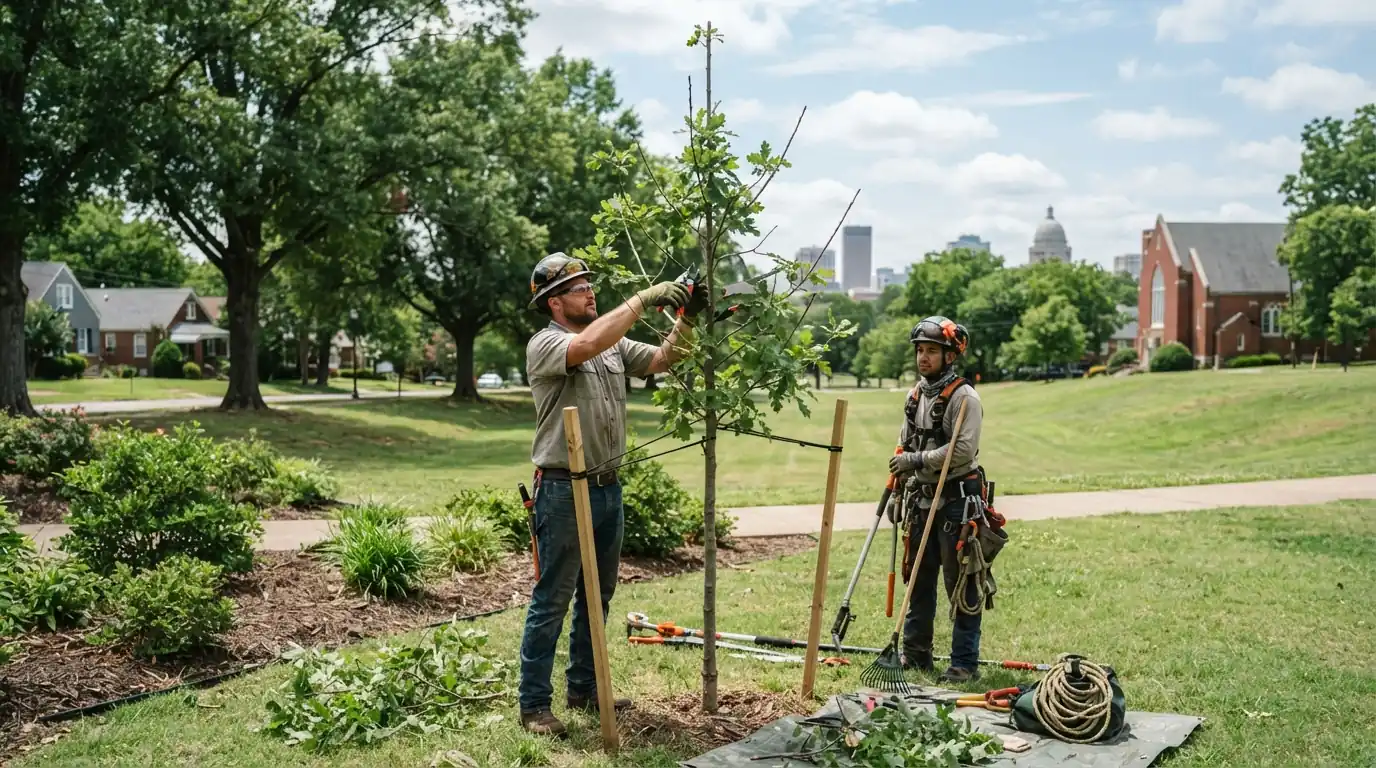
Small cuts close quickly and leave little room for decay. The same correction on a mature tree means a large wound, more cost, and sometimes cabling or removal.
Structural pruning is light work: a few cuts each visit, spread over years, so the tree keeps plenty of leaves to grow while its framework is set.
Choosing a central leader
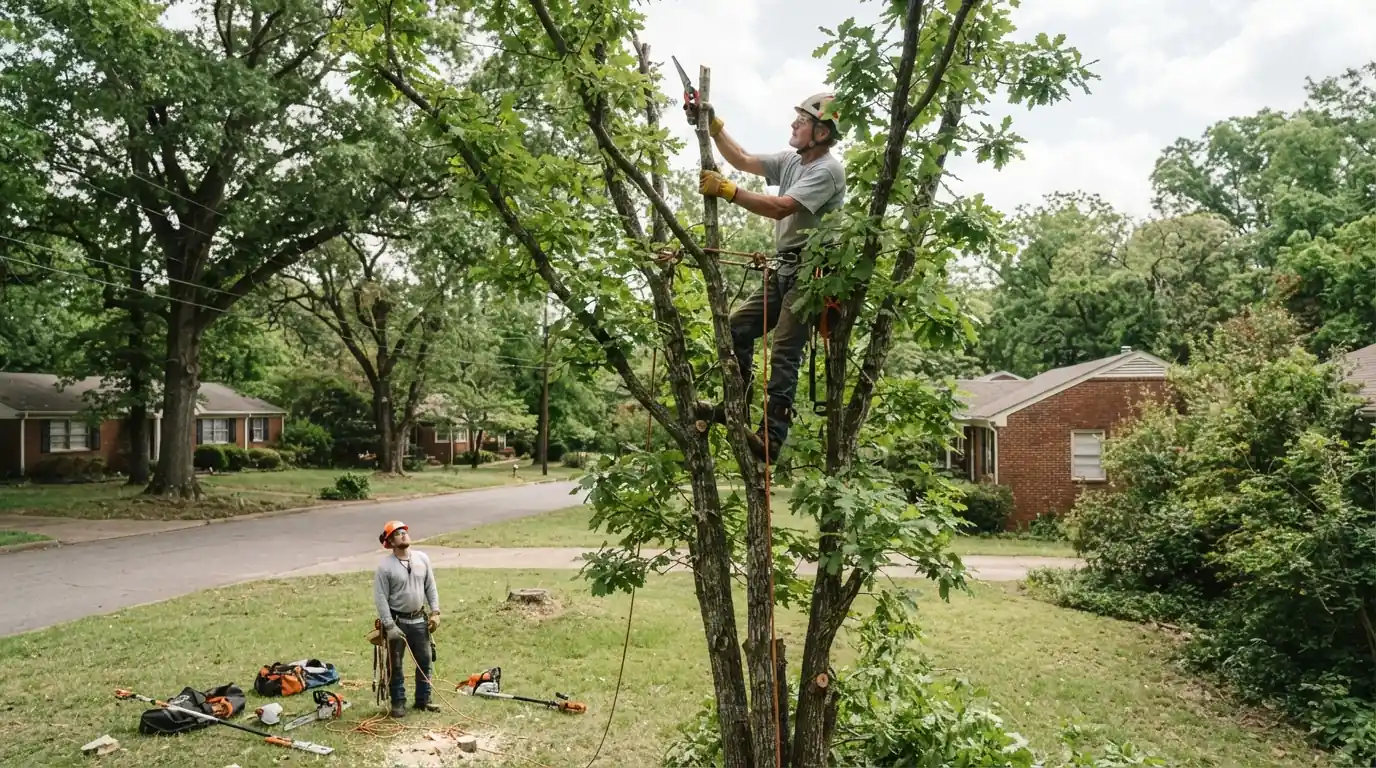
Many young shade trees grow two or three tops of similar size. Left alone, they become codominant trunks with a weak union, the kind that splits in ice or wind decades later. We pick the strongest, straightest leader and shorten or remove the competitors, so the tree grows one trunk with branches attached properly to it. On some species a gentle reduction of the rival is better than removing it outright, and we explain which approach fits your tree and why.
Local market guidance: $375 to $525, average about $450 (planning range from published 2026 figures, not our quote; every job is priced on site).
Fixing crossing and crowded branches
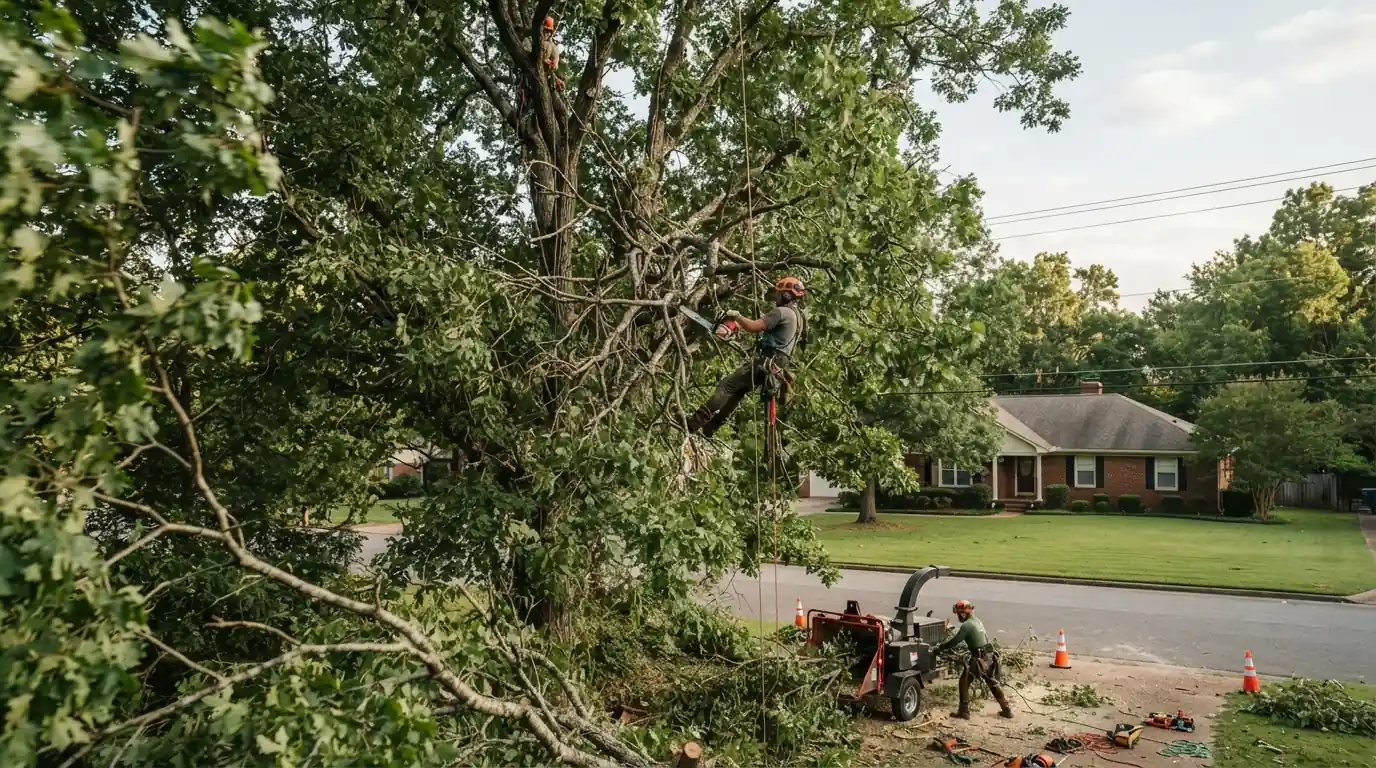
Branches that rub each other wear through the bark and invite decay; branches bunched at one height on the trunk weaken it. We remove crossing limbs, space the permanent branches up the trunk, and take out any that grow back toward the center of the tree. The goal is a framework that will still make sense when the tree is fifty feet tall. Low branches that will eventually block the drive or walk are shortened now rather than removed all at once, so the young trunk keeps its taper and strength.
Pruning after planting
A newly planted tree needs very little: broken or dead twigs removed, and nothing else in the first year while the roots establish. From the second or third year, light structural cuts begin. We also check stakes and ties on young trees, since forgotten ties girdle trunks, and look for trees planted too deep, a common reason young trees struggle. Mulch piled against the trunk gets pulled back into a flat ring, since a mulch volcano keeps the bark wet and invites rot at the base.
How this job runs around Little Rock
Bradford pears are the clearest local example of what poor early structure does. University of Arkansas extension notes the trees do not weather well over time, and their tight, crowded branch unions are why so many Little Rock pears split in their second or third decade. Young oaks, maples and other shade trees can fail the same way if they are left with competing leaders, which is what early structural pruning prevents.
Honest comparison
Pruning young trees yourself vs calling a crew
| Part of the job | On your own | With our crew |
|---|---|---|
| Broken twigs | Easy with hand pruners | Done during the visit |
| Choosing the leader | Easy to pick the wrong one | Chosen for long-term structure |
| How much to cut | Tempting to cut too much | Only what the tree needs |
| Cut placement | Stubs or flush cuts | Just outside the collar |
| Stakes and ties | Often forgotten | Checked and removed |
| Long-term plan | Hard to track over years | Planned visit to visit |
Step by step
How a young tree visit goes
- 1
Call about your young trees
How many, how old, and what they are.
- 2
Look at each tree's structure
Leader, forks, spacing and ties.
- 3
Make a small number of cuts
Only what the tree needs this year.
- 4
Check stakes and planting depth
Ties loosened or removed.
- 5
Plan the next visit
Structure is built over several years.
What moves the price
What decides the price of young tree pruning
Local market guidance: $375 to $525, average about $450 (planning range from published 2026 figures, not our quote; every job is priced on site).
Number of trees
Several young trees pruned in one visit.
Tree age and size
Trees under twenty feet go quickly.
Amount of correction
Trees left untrained longer need more cuts.
Stake and tie checks
Removing or loosening old ties.
Species
Some trees need extra care with cut timing.
Cleanup
Small brush chipped or bagged.
Straight answers
Questions we get about this
Remove only broken twigs the first year; start structural cuts in year two or three.
Every one to three years while the structure is set.
The single main trunk that continues to the top of the tree.
Usually within the first year. Ties left on too long can girdle the trunk.
No. That needs the root flare exposed, which we can check.
Yes. It is the cheapest way to prevent splits and large cuts later.
General pruning runs about $375 to $525 by published 2026 figures; young trees usually cost less.
Related work
Other jobs we handle near this one
Service-Line Clearance Trimming
Limbs on the Service Drop to the House and more.
Need service-line clearance trimming?Crape Myrtle Pruning
Removing Old Seed Heads and Suckers and more.
More on crape myrtle pruningMaple Tree Trimming
Red and Silver Maple Limbs and more.
Maple Tree Trimming
Set your young trees up right
Call any hour. We will look at each young tree and make only the cuts it needs this year.