Answered 24/7 across Little Rock and the Texarkana area
Tree risk assessment for Little Rock homes and lots
Most trees people worry about are fine. Some that nobody worries about are not. A risk walk-through looks at the parts that fail, roots, trunk, unions and crown, and ends with a plain answer: leave it, prune it, brace it, or take it down.
- Root, trunk and crown check
- Plain save-or-remove answer
- Answered 24/7
Short answer
A tree risk assessment in Little Rock is a walk-around check of the roots, trunk, branch unions and crown for the defects that make trees fail, weighed against what the tree would hit. It ends with one of four answers: leave it, prune it, cable or brace it, or remove it. Pines and oaks fail differently here, so each gets checked for different things.
Updated October 2026
Scope
What a risk walk-through checks
- Root flare and soil around the base
- Lean and any fresh soil heaving
- Trunk for cracks, cavities and conks
- Branch unions for splits and included bark
- Crown for deadwood and hangers
- Clearance from roof, lines and driveway
- A plain recommendation with a timeline
What we look at, and why
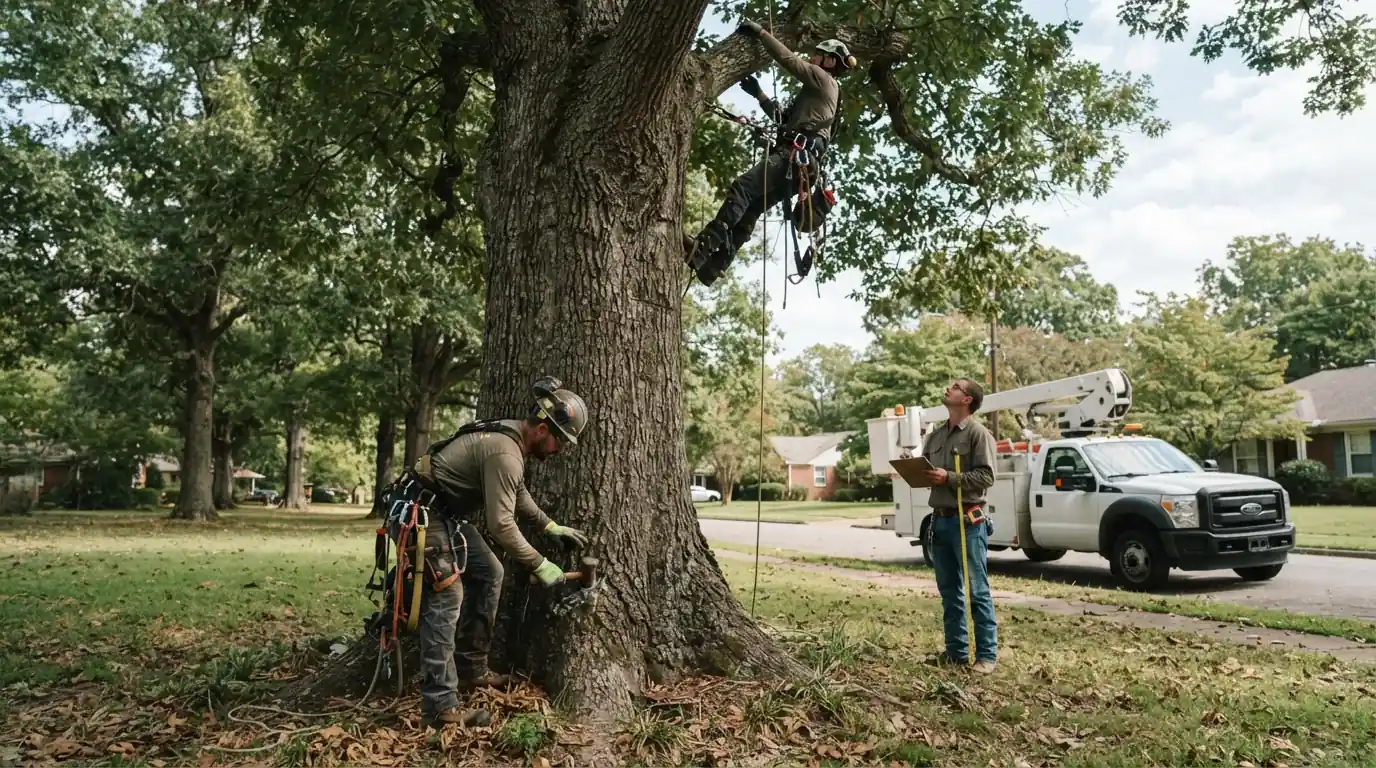
Trees rarely fail without warning signs. Fungal conks at the base, cracks through a union, soil heaving on one side, a hollow sound when the trunk is struck: each points to a specific failure.
Risk is not only about the tree. A decayed oak over an empty field is a lower priority than a sound-looking one leaning over a bedroom. We weigh both, then give you an honest recommendation.
Leaning or cracked trees
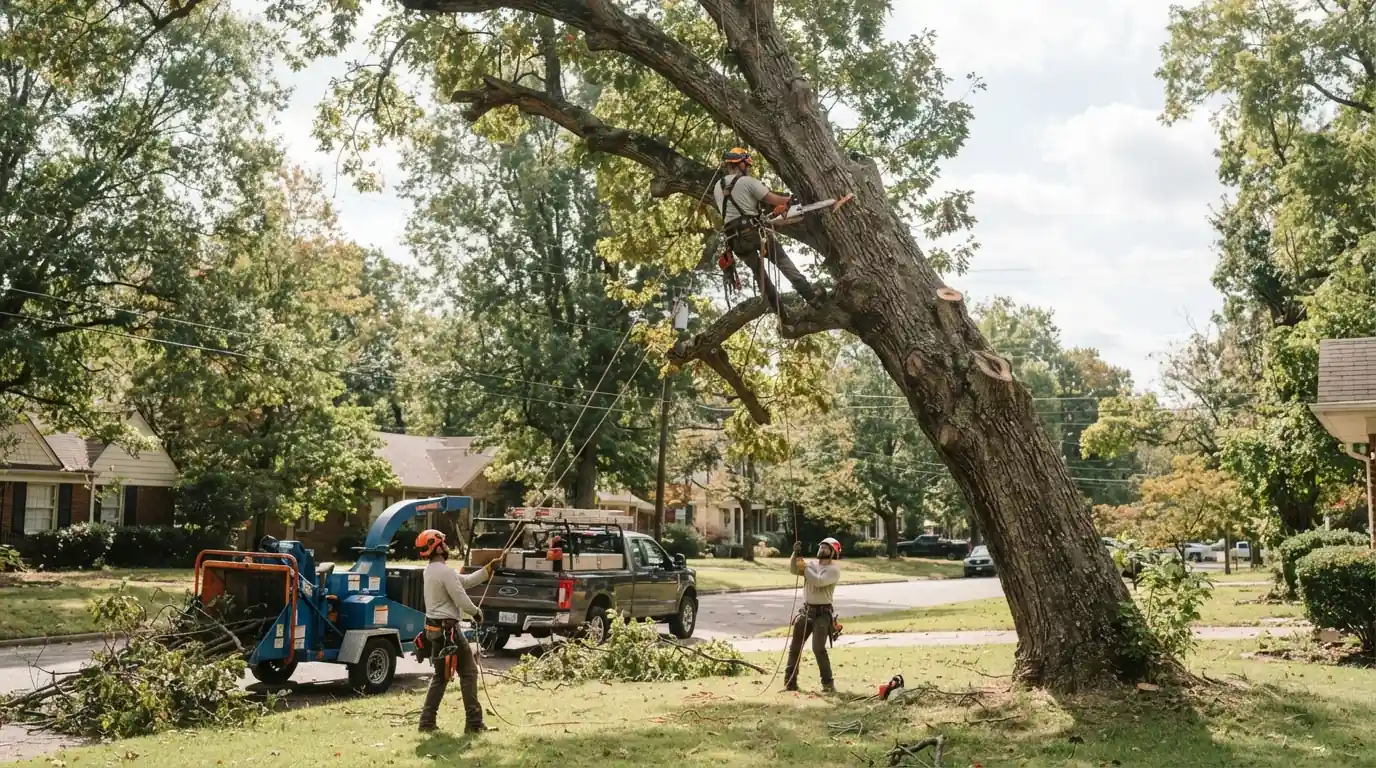
A lean the tree grew into is normal. A lean that appeared recently, with soil lifted or roots snapped on the far side, is not. We check the root plate, look for fresh cracks in the soil, and compare the lean to photos if you have them. Cracks running through the trunk or down from a union are checked for length and movement; some can be cabled, some mean the tree is splitting and should come down before the next wind does it for you.
Fungal conks and cavities
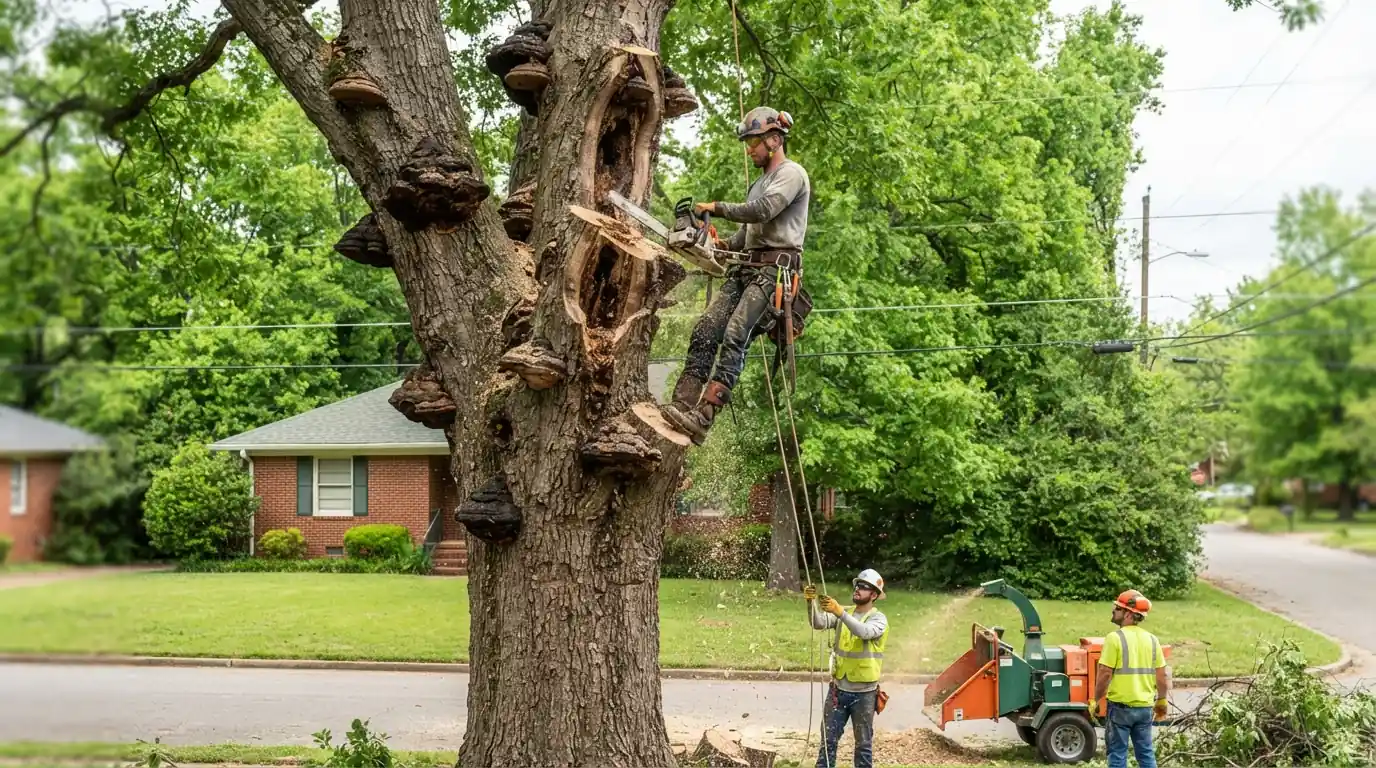
Shelf-like fungi on the trunk or at the root flare mean decay inside. The conk tells us roughly what kind of rot it is and how it spreads. We sound the trunk with a mallet and probe cavities to estimate how much sound wood is left around them. A small cavity in a strong trunk can be ignored; a large one near the base with a thin shell is a serious concern and often decides the call, especially when the tree leans toward the house.
Pre-purchase property walk
Buying a house with big trees? A walk-through before closing tells you which trees are assets and which are future removal bills. You get notes on each tree near the house, driveway and lines, with our honest view of what needs doing and how soon. It is not a formal appraisal, but it is the conversation most buyers wish they had before the first storm season. We can also flag trees whose roots are near the sewer line or the foundation, which is a separate cost many buyers never hear about until they own it.
Storm-season check
Before spring storms or winter ice, a quick check of the trees closest to the house catches the limbs most likely to fail: long heavy limbs over the roof, deadwood, and weak V-shaped unions. Those are fixed with pruning or cabling far more cheaply than cleanup after they come down. We also look for trees that lost roots in trenching or construction nearby, since root loss often shows in the crown a year or two later, long after anyone connects it to the work.
How this job runs around Little Rock
The March 31, 2023 tornado gave Little Rock a clear lesson in how different trees fail. In Walnut Valley, Leawood and Burns Park, pines went over root plate and all while oaks snapped at the trunk. So on a pine we look hardest at the root zone and soil; on an oak we look at the trunk, unions and decay. After storms, UAEX guidance helps too: most hardwoods losing 25 to 75 percent of the crown survive, and trees past 75 percent usually do not.
Warning signs
Signs a tree needs a closer look
Mushrooms or conks at the base
Fungal growth usually means decay in the roots or trunk.
New lean with lifted soil
The root plate is moving.
Cracks through a union
Two stems pulling apart where they meet.
Dead limbs over the roof
Brittle wood that can drop without warning.
Bark falling off in patches
Dead wood underneath or active decay.
Sparse crown or early leaf drop
Root problems or decline showing at the top.
Step by step
How a risk walk-through goes
- 1
Call and tell us the concern
Which tree, what you noticed, and what is under it.
- 2
Walk the site together
Roots, trunk, unions and crown checked from the ground.
- 3
Sound and probe
Suspect decay checked with a mallet and probe.
- 4
Weigh the target
What the tree would hit if it failed.
- 5
Plain recommendation
Leave, prune, brace or remove, and how soon.
What moves the price
What decides the cost of a risk walk-through
Number of trees
One worrying tree versus a whole property.
Tree size
Big oaks take longer to inspect around the crown.
Access
Trees on steep or overgrown ground take longer to walk.
Written notes
A tree-by-tree summary for a purchase or HOA.
Follow-up work
Pruning or cabling is priced separately if you want it.
Urgency
After-storm checks are scheduled first.
Straight answers
Questions we get about this
No. It is a hands-on crew lead assessment in plain language. If you need a formal report for a legal or insurance matter, say so and we will point you in that direction.
No. Most trees we check need pruning or nothing at all. Removal is recommended only when the defect warrants it.
A new lean with lifted or cracked soil on the far side is the warning sign.
Usually root or butt rot. It needs a closer look, especially if the tree is near the house.
It is worth it when big trees stand close to the house, driveway or lines.
Sometimes with cabling and bracing, if the crack is not too long and the wood is sound.
Every few years, and after any storm that drops limbs in the yard.
Related work
Other jobs we handle near this one
Tree Protection During Construction
Root Zone Fencing and more.
Need tree protection during construction?Vine & Ivy Removal from Trees
English Ivy on Trunks and more.
Need vine & ivy removal from trees?Deep Root Fertilization
Stressed Trees After Construction and more.
Deep Root Fertilization
Get an honest answer about that tree
Call any hour and tell us which tree worries you. A crew lead walks it with you and gives you a straight answer.