Answered 24/7 across Little Rock and the Texarkana area
Tree cabling and bracing for Little Rock trees worth keeping
Many big trees grow two or three main trunks from one union, and that union is where they tend to split. A steel cable high in the crown and a brace rod through the union can keep a good tree standing for years.
- Codominant trunk cabling
- Brace rods for split unions
- Answered 24/7
Short answer
Tree cabling and bracing in Little Rock adds support to weak unions using steel cable installed high in the crown and threaded rods through the trunk. It suits healthy trees with V-shaped unions or early cracks, not trees already failing or decayed through. Cables need checking every few years because trees grow and hardware ages.
Updated October 2026
What cables and braces actually do
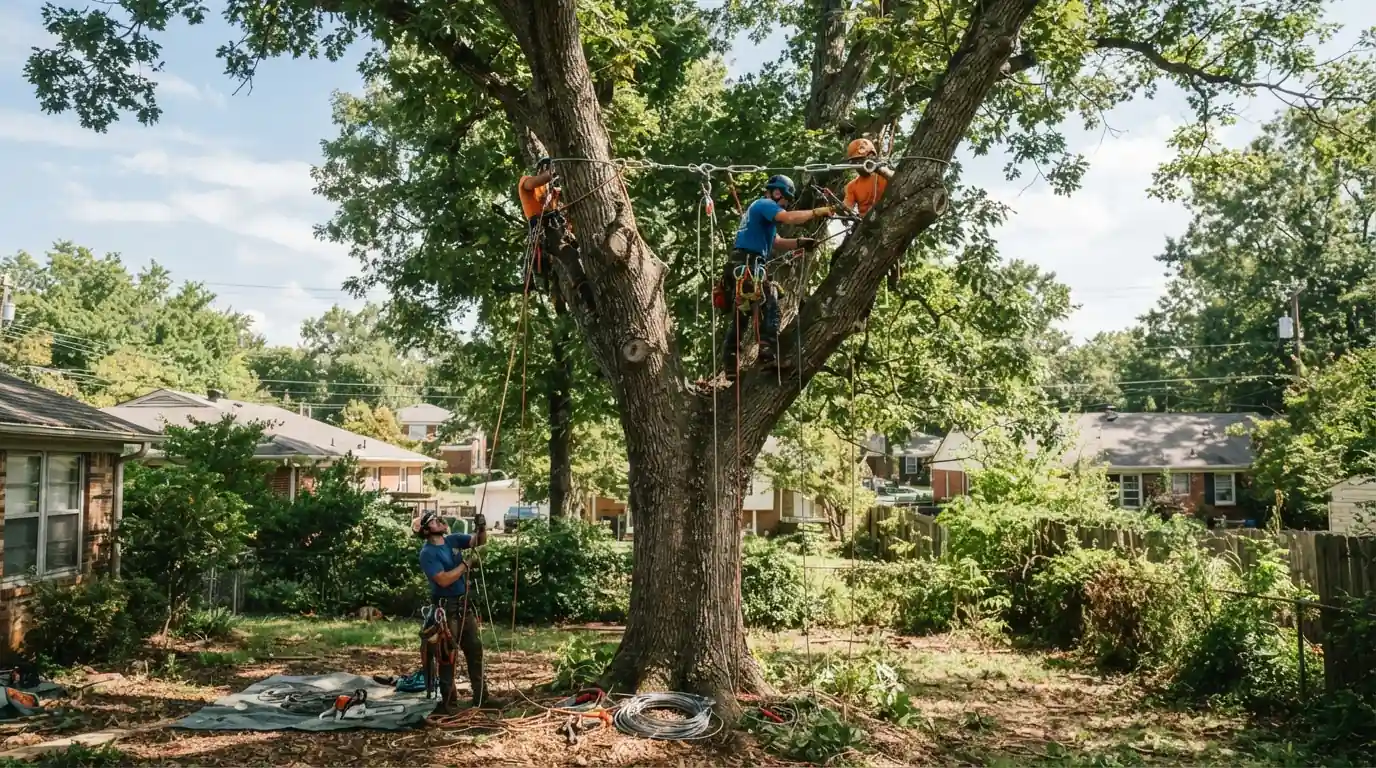
A cable connects two stems about two-thirds of the way up, limiting how far they can move apart in wind or under ice. A brace rod goes through the trunk near the union to hold a crack or weak union together.
Neither makes a weak tree strong. They reduce the load on a defect so a sound tree can keep growing with less risk. We pair them with pruning to lighten the stems they support.
Compare
Support it, lighten it or remove it
| Factor | Cable and brace | Weight reduction only | Remove the tree |
|---|---|---|---|
| Tree condition | Sound wood, weak union | Sound, heavy ends | Decay or open split |
| Cost now | Moderate | Lower | Higher, one time |
| Upkeep | Rechecks every few years | Pruning every few years | None |
| Risk after | Reduced | Reduced somewhat | Gone |
| Tree kept | Yes | Yes | No |
What moves the price
What decides the price of cabling and bracing
Number of cables
One cable between two stems versus a multi-stem system.
Tree height
Anchors go about two-thirds up the crown.
Brace rods
Drilling and setting rods adds time.
Weight reduction pruning
Often done together to lighten the stems.
Hardware type
Through-bolts versus lag hardware for the tree's size.
Existing hardware
Removing or replacing old cables.
Codominant trunk cabling
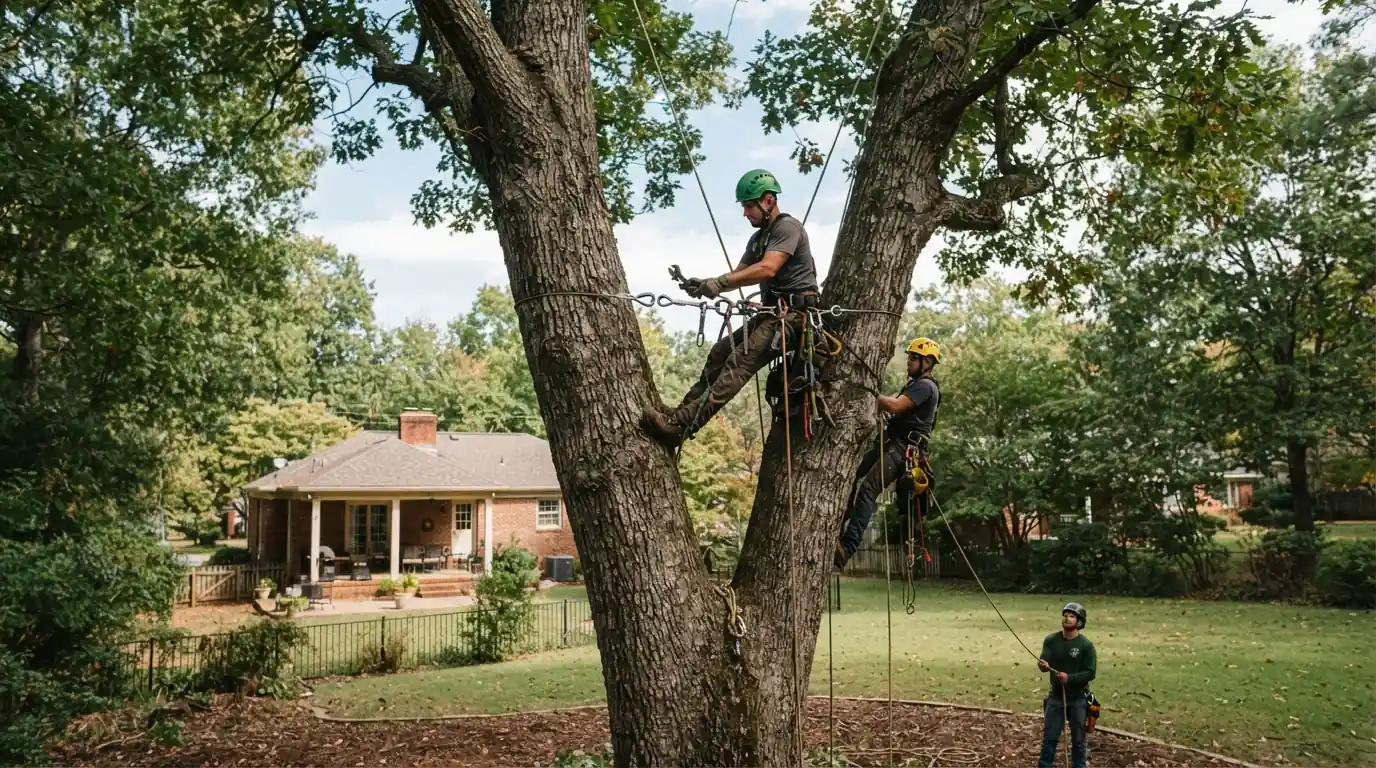
Two trunks of similar size growing from one point, often with bark squeezed into the union, are the classic case. The union has little wood holding it and splits under load. A cable between the stems, anchored with through-bolts or lag hardware, stops them pulling apart. We usually reduce some weight on each stem at the same time so the cable works with less strain. It is common on older oaks and maples in town, and cabling one early costs far less than cleaning up after a split.
Bracing a split union
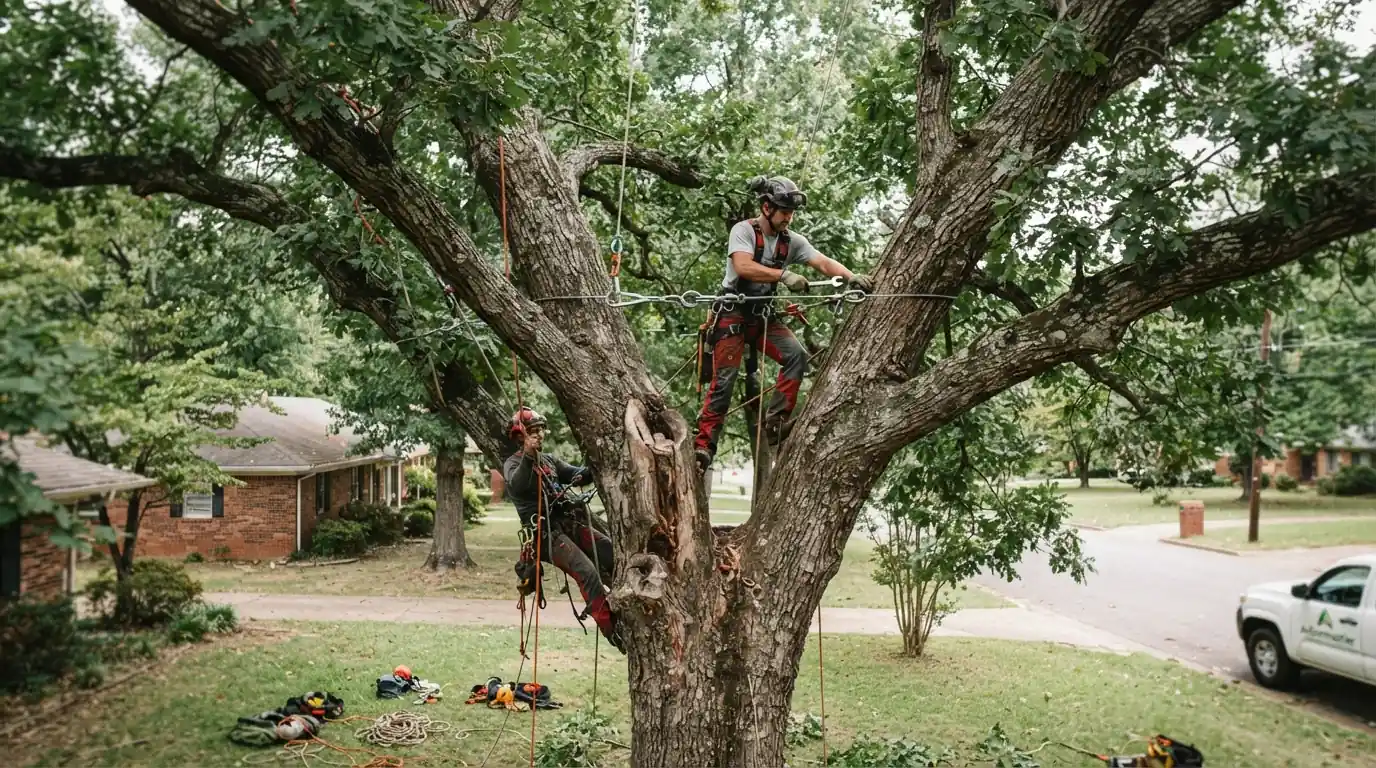
When a crack has already started at a union, a brace rod can pull it together and stop it opening further. We drill through the trunk, set threaded rod with washers and nuts, and usually add a cable above. Whether bracing is worth it depends on the crack: short and tight in sound wood, often yes; long, open or with decay behind it, removal is the safer choice. We show you the crack from the ground or with photos from the climb so you see what we see before you decide.
Cable inspection and adjustment
Cables stretch, hardware corrodes, and the tree grows around anchors. We check existing cables for slack, wear and wood grown over the hardware, and adjust or replace them. A cable that has gone slack gives no support at all, and one rubbing on bark can damage it. If you bought a house with cables already in a tree, it is worth having them checked, since nobody may have looked at them in years. Old cables that are no longer doing anything useful can be removed.
How this job runs around Little Rock
Ice is the load that finds weak unions. The December 2000 ice storms put more than an inch of ice across Little Rock and North Little Rock, and many trees split at the fork between two trunks, where the added weight pried the stems apart. A cable does its best work in exactly that moment, holding the stems together while they carry ice. For a big tree over a Little Rock roof, cabling before winter is the cheaper choice.
Warning signs
Signs a union needs support
V-shaped fork
Two similar trunks with a narrow angle between them.
Bark squeezed into the union
A seam of bark instead of wood holding the stems.
Crack below the fork
A split running down from where the stems meet.
Stems moving apart in wind
Visible spreading on windy days.
Old cable gone slack
Hardware no longer holding any load.
Sap or ooze from the union
Fresh cracking or decay at the fork.
Step by step
How a cabling job goes
- 1
Call about the tree
Tell us about the fork, crack or old cable you noticed.
- 2
Inspect the union
Check the crack, the bark, and for decay.
- 3
Recommend the fix
Cable, brace, prune, or remove if it cannot be saved.
- 4
Install the hardware
Anchors set, cable tensioned, rods through the union.
- 5
Schedule rechecks
Hardware inspected every few years.
Straight answers
Questions we get about this
Anchors make small wounds the tree seals around. Properly installed, the benefit far outweighs the harm.
Many years, but they need inspection every few years and adjustment as the tree grows.
No. Decay behind a crack or a long, open split usually means removal.
They sit high in the crown and are hard to spot once the tree leafs out.
Yes. Ice is one of the heaviest loads a union carries.
No. We usually lighten the stems too.
Yes, if they are no longer needed or are damaging the tree.
Related work
Other jobs we handle near this one
Vine & Ivy Removal from Trees
English Ivy on Trunks and more.
Vine & Ivy Removal from Trees in Little RockTree Transplanting
Moving Young Trees and more.
Need tree transplanting?Tree Risk Assessment
Leaning or Cracked Trees and more.
See how tree risk assessment works
Keep a good tree standing
Call any hour and tell us about the fork or crack. We will check it and tell you honestly whether cabling is worth it.