Answered 24/7 across Little Rock and the Texarkana area
Deep root fertilization for Little Rock shade trees
Fertilizer is not medicine. A tree that is thinning because of root damage, drought or disease will not be fixed by feeding it. But trees growing in poor or compacted soil, or recovering from construction, can benefit from the right nutrients delivered where the roots are.
- Soil test first
- Root zone feeding
- Answered 24/7
Short answer
Deep root fertilization in Little Rock delivers nutrients into the root zone of a tree, usually by injecting a liquid fertilizer into the soil under the canopy. It works best when a soil test shows what is actually lacking, on trees stressed by compacted soil, construction or poor urban ground. It does not cure disease or insect problems, and we tell you honestly when the cause is something else.
Updated October 2026
When feeding a tree helps
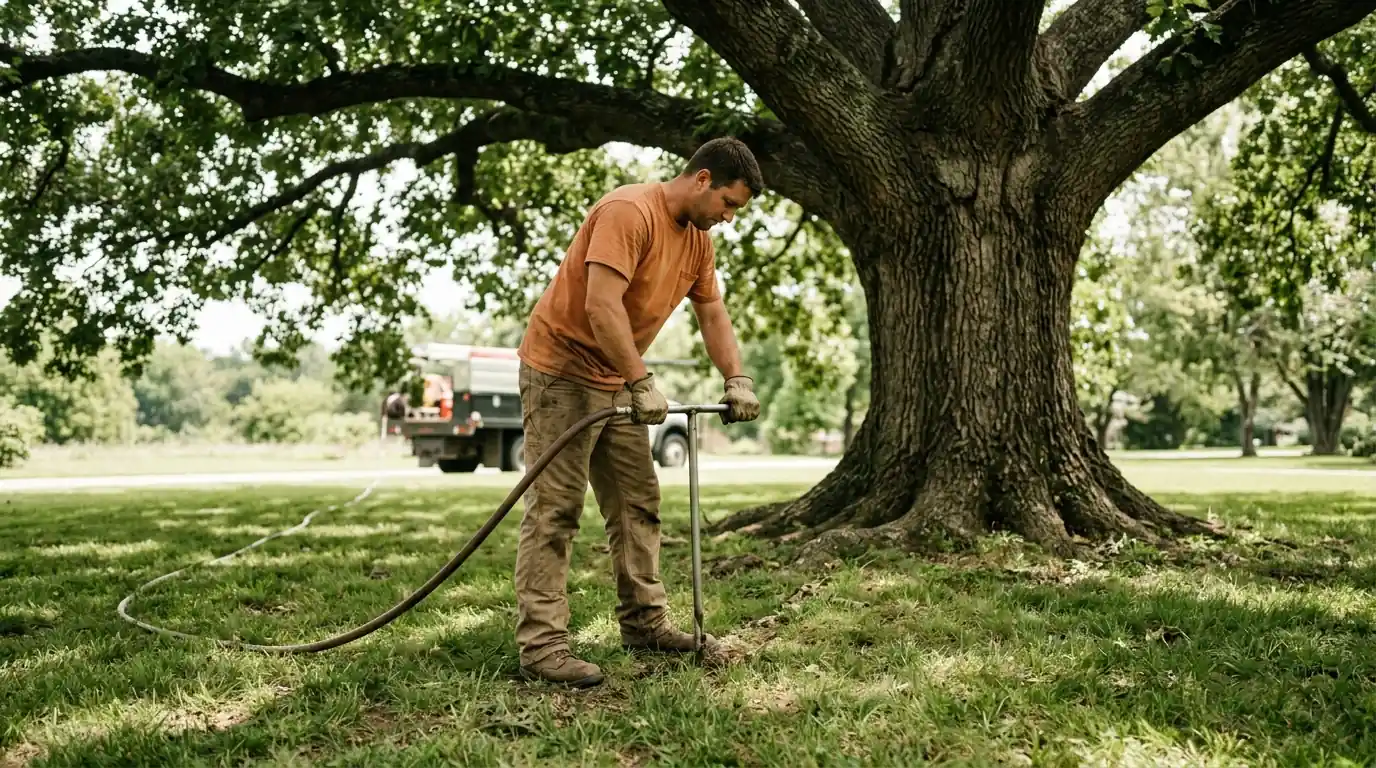
Trees in forests feed themselves from fallen leaves. Yard trees have their leaves raked away, their roots under lawn and pavement, and soil compacted by traffic. Over years, some run short of nutrients or struggle to take them up.
The first step is finding out what is wrong. Pale leaves, small leaves and thin crowns can come from many causes, and feeding a tree that needs something else wastes money.
Stressed trees after construction
Trees that lost roots or had soil compacted during building often decline for a few years afterward. Feeding cannot regrow cut roots, but alongside mulching and watering it can support the roots that remain while the tree recovers. We look at what happened during the work first, because a tree with most of its roots cut on one side may be a safety question rather than a feeding one. Recovery, when it happens, is measured in years, so we set expectations honestly.
Soil testing first
A soil test shows the pH and the nutrients that are actually low, so the fertilizer can be chosen to match. Many county extension offices in Arkansas run soil tests, and we can take samples from the root zone for you. Feeding without a test often adds nutrients the tree already has, which does nothing for it and can wash into storm drains. The test also shows soil pH, which on some lots matters more than any fertilizer, because nutrients already in the soil can be locked up when the pH is off.
Feeding mature shade trees
For big shade trees, fertilizer is injected into the soil in a grid under the canopy and out past the drip line, where the feeding roots are. Slow-release blends feed the tree gradually rather than forcing a flush of weak growth. Most healthy mature trees need feeding only occasionally, if at all; we will not sell it to a tree that does not need it. A wide ring of wood-chip mulch over the root zone, renewed each year, often does as much good as fertilizer by feeding the soil slowly.
How this job runs around Little Rock
Many Little Rock yard trees grow in tough conditions: heavy clay, compacted lawns, roots under driveways and sidewalks, and leaves raked away every fall. That is where a measured feeding program can help, and where we start with the soil rather than the fertilizer. Trees across the metro, from the older neighborhoods to new subdivisions built on graded ground, can run short of what they need.
Warning signs
Signs a tree may need feeding
Pale or yellowing leaves
Can point to a nutrient shortage or pH problem.
Small leaves
Leaves smaller than normal for the tree.
Thin crown
Fewer leaves than in past years.
Short new growth
Twigs adding little length each year.
Early fall color
Leaves turning before neighbors' trees.
Recent construction nearby
Roots stressed or soil compacted.
Honest comparison
Feeding a tree yourself vs calling a crew
| Part of the job | On your own | With our crew |
|---|---|---|
| Lawn fertilizer near a tree | Feeds the grass more than the tree | Root zone feeding under the canopy |
| Knowing what is lacking | Guesswork | Soil test first |
| Finding the real cause | Easy to miss root or pest problems | Checked before feeding |
| Product choice | General-purpose blends | Matched to the test |
| Amount | Easy to overdo | Measured for the tree |
| Follow-up | Often forgotten | Planned with mulch and water |
Step by step
How a feeding visit goes
- 1
Call about the tree
What you are seeing and for how long.
- 2
Look for the real cause
Roots, drought, pests or soil.
- 3
Test the soil
Samples from the root zone.
- 4
Feed the root zone
Injected under and beyond the canopy.
- 5
Plan the follow-up
Mulch, water and recheck.
What moves the price
What decides the price of fertilization
Tree size
Larger root zones take more product.
Number of trees
Several trees in one visit.
Soil test
Samples taken and sent for testing.
Product chosen
Matched to what the test shows.
Access
Room to work under the canopy.
Follow-up
Repeat feeding only if needed.
Straight answers
Questions we get about this
Not if the cause is root damage, disease or insects. It helps trees short of nutrients.
It is the best way to know what the tree actually needs.
Only when a test or symptoms show a need; healthy trees often need none.
Fertilizer injected into the soil where the feeding roots are.
Both can work; timing depends on the tree and the product.
Too much, or the wrong kind, can. That is why we test first.
A wide mulch ring, deep watering in dry spells and protecting the roots.
Related work
Other jobs we handle near this one
Tree Planting
Shade Tree Planting and more.
More on tree plantingTree Transplanting
Moving Young Trees and more.
See how tree transplanting worksVine & Ivy Removal from Trees
English Ivy on Trunks and more.
See how vine & ivy removal from trees works
Tree looking tired?
Call any hour. We will look for the real cause before suggesting any feeding.